
India has successfully conducted a flight test of an advanced Agni missile featuring Multiple Independently Targetable Re-entry Vehicle (MIRV) technology off the coast of Odisha.
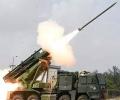
The Army is also looking at strengthening the existing Pinaka regiments and had recently placed orders for buying the area denial ammunition for these rocket regiments.

Three milestones in three days signal India's growing mastery in next-generation strategic technologies spanning nuclear deterrence, hypersonic propulsion and precision stand-off strike capability.

Army Chief General Upendra Dwivedi emphasized the importance of indigenous equipment for the Indian Army, highlighting the force's modernization efforts and readiness for future warfare.

The Armoured Corps Centre and School and Mechanised Infantry Centre and School traces its lineage back more than two centuries, evolving from early cavalry regiments into a modern force comprising 67 armoured regiments, including the President's Bodyguard. The centre showcased the operational capabilities of manoeuvre warfare platforms of the Indian Mechanised Forces during the Integrated Fire Power & Manoeuvre Exercise: 2026 held at the Kharjuna Khare Ranges in Ahilyanagar (formerly Ahmednagar), Maharashtra, on January 20, 2026.

India successfully test-fired two Pralay missiles in quick succession off the coast of Odisha, paving the way for its induction into the military. The missile is indigenously developed and features a state-of-the-art navigation system.
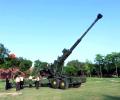
The ATAGS has a range of 35-45 kilometres, depending on the ammunition used, and achieved a 47-km firing range during trials.

During the financial year 2025-2026, the defence ministry has signed a total of 182,492 crore capital acquisition contracts, highlighting the government's push to modernise the armed forces and promote indigenous defence production.
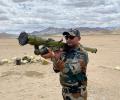
The new supplies of the Igla-S air defence missiles have been received by the Indian Army a couple of weeks ago and are being provided to the forward formations for taking care of the threat from enemy fighter aircraft, choppers and drones on the borders.

Nishant, a remotely piloted vehicle (RPV) designed and developed by ADE, has an endurance of four to five hours and a range of 100 km in its primary roles. Flying at a speed of 40 to 60 metres per second, the UAV is capable of relaying data in real time to the army units moving forward in a battlefield condition.

AI reduces the time taken to find a target and launch a strike. This has led to a major increase in the pace of the conflict, with one report mentioning nearly 900 strikes launched on Iranian targets in the first 12 hours of an operation.

We must seize the opportunity provided by the COVID-19 crisis to kick-start indigenous research efforts, recommends Colonel Anil A Athale (retd).

In 2025-26, the government allocated Rs 6,81,210 crore for defence budget.
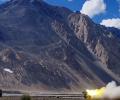
The successful validation will speed up induction and significantly bolster India's air defence posture in sensitive frontier zones.

China has confirmed providing on-site technical support to Pakistan during last year's conflict with India, according to official media reports.

Around 100 artistes heralded the parade, on the theme 'Vividata Mein Ekta (Unity in Diversity) that featured a grand presentation of musical instruments, demonstrating the nation's unity and rich cultural diversity.

61 Cavalry, Bhairav light commando battalion, DRDO's Long Range Anti-Ship Hypersonic Missile (LR-AShM) and many more key military assets were part of a grand Republic Day Parade in New Delhi.

The missile was showcased at the recent Dubai Air Show and drew huge interest from potential buyer countries.
'The tools of warfare are changing. The MoD must deepen its engagement with technology thinkers that can present compelling visions of where warfare may be heading.'

It said the tests were carried out against high-speed unmanned aerial targets under different interception scenarios.

India successfully test-fired nuclear-capable short range ballistic missiles Prithvi-II and Agni-I from an integrated test range off the Odisha coast, demonstrating its strategic deterrence capability. The test-firing of the missiles, conducted by the elite Strategic Forces Command, validated all operational and technical parameters.

The jackets have been developed at the DRDO Industry Academia Centre of Excellence at IIT-Delhi, the ministry said in a statement.

The 15th India-Vietnam Defence Dialogue signalled a move from routine talks to deeper cooperation, with new deals on submarine rescue and defence industry to support stability in the Indo-Pacific, notes Dr Rajaram Panda.

The Defence Research and Development Organisation has developed a lightweight bullet-proof jacket that weighs nine kilogram and meets the qualitative requirements of the Indian Army, the defence ministry said on Thursday.

The Dhurandhar movies will undoubtedly shape the minds of the audience much more than news reports, court investigations, books and documentaries. But it is worth remembering that Pakistan's irridentist claims against India's national security have succeeded due to strategic planning, diplomacy, and the unsung heroines and heroes across government agencies, not due to a single maverick leader, points out Shweta Desai.But it is worth to remember that Pakistan's irredentist claims against India's national security have succeeded due to strategic planning, diplomacy, and the unsung heroines and heroes across government agencies -- not a single maverick, points out Shweta Desai.
'A crucial role in bolstering the Indian Army's firepower by enabling precise and long-range strikes.'
When the armoured vehicles arrive in this 'kill zone', each PALM 400 picks out its target and fires an armour-penetrating projectile, penetrating it from the top where its armour protection is the least.

The army has long been deficient in artillery, the modern battlefield's most lethal killer, says Ajai Shukla.

The Army has now fallen behind the other two services for four years in a row.
'If you take any ministry of defence project, Nibe is up there, getting orders.'

Like most army combat uniforms, this one has been designed to serve two requirements: First, protection against harsh climatic conditions, including extreme heat and cold. Second, the need to provide soldiers' outfits with field camouflage, so as to increase his battlefield survivability.
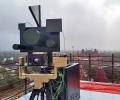
In order to have protection against drone attacks, all the three defence forces including the Army, Navy and Air Force have signed contracts for acquiring DRDO-developed anti-drone systems.

The setting up of STEAG is part of the Army's efforts to develop technologies considering the future battlefield, they said.
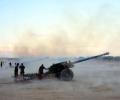
The Indian Army is enhancing the combat prowess of its artillery units along the frontier with China by procuring an array of weapons systems, including an additional batch of 100 K9 Vajra howitzers, swarm drones, loitering munitions and surveillance systems.

The Akash weapon system, which will be deployed facing the western borders, employs command to line of sight guidance and relies on sophisticated radars and control systems to guide the missile to its targets.
In a major boost to indigenous defence capabilities, the Indian army has assured the Defence Research and Development Organisation an order for over 140 howitzers once the premier research agency proves its artillery guns which are under development.

The QRSAM system is unique in its ability to operate on the move, searching for and tracking enemy targets; and then fire on a short halt.

The Indian Navy, which was earlier looking towards the US for design expertise, technical know-how and operational practices, is now considering the advantages of working with the Royal Navy.

The Indian Air Force is set to retire its fleet of MiG-21 fighter jets at a decommissioning event in Chandigarh. The event will mark the end of an era for the aircraft that has been a key part of the IAF's combat fleet for over six decades.

The Enhanced Pinaka has demonstrated a range of 75 km and an ability to strike within 10 metres of where it is aimed. This allows a Pinaka battery to destroy a terrorist camp, or an enemy post, logistics dump or headquarters, without sending soldiers across the border.
 © 2026 Rediff.com - Advertise with us - Disclaimer - Privacy Policy - Sitemap - Feedback - About us - Terms of use - Grievances